free shipping on purchases over R500
- The safest way to collect colostrum is by hand expressing.
- All you need to do is begin massaging your breast from the top down towards your nipple, then after a few minutes, cup your breast, placing four fingers underneath and your thumb on top like a ‘c’ shape. Use your thumb and index finger to gently squeeze round the nipple and collect the colostrum with an oral syringe. Try a different area of the same breast until no more production and then move onto the other breast.
- Collecting colostrum to feed to your baby is highly beneficial as it’s packed full of calories, antibodies and stem cells, which is ideal for the first steps in development.
- You shouldn’t use a breast pump to collect colostrum prior to birth as this has a higher chance of causing uterine contractions, which could lead to premature labour.
Hand expression of colostrum means you have some nutrient-rich milk ready to give to your baby when they’re born. It’s a great step for anyone who is pregnant and can help you feel more prepared for breastfeeding.
But what is colostrum and why do we recommend giving it to your baby?
Here’s everything you need to know about colostrum’s benefits, as well as our tips on how to express colostrum safely and comfortably.
What is colostrum and what are its benefits?
Colostrum is the first breast milk your body produces in the later stages of pregnancy. Healthy colostrum is thick and sticky in consistency, and usually yellow, clear, or milky coloured. It’s high in calories, full of antibodies and packed with stem cells, which are ideal for your baby’s health and first steps in development.
Who needs to collect colostrum?
Collecting colostrum before birth is beneficial for any pregnant person, but it’s particularly recommended if you:
- are diabetic or have developed diabetes during pregnancy,
- take beta blockers,
- have developed pre-eclampsia during pregnancy,
- have breast hypoplasia or have had breast surgery,
- have polycystic ovary syndrome,
- have a raised BMI (body mass index),
- are expecting twins,
- are planning a caesarean section delivery,
It can also help if your baby’s likely to experience issues with their blood sugar levels or may struggle to feed after birth because they:
- are larger or smaller in size than expected for their gestational age,
- are a multiple (twin or triplet),
- have a cleft lip palate or lip,
- have Down’s syndrome,
- have a heart condition.
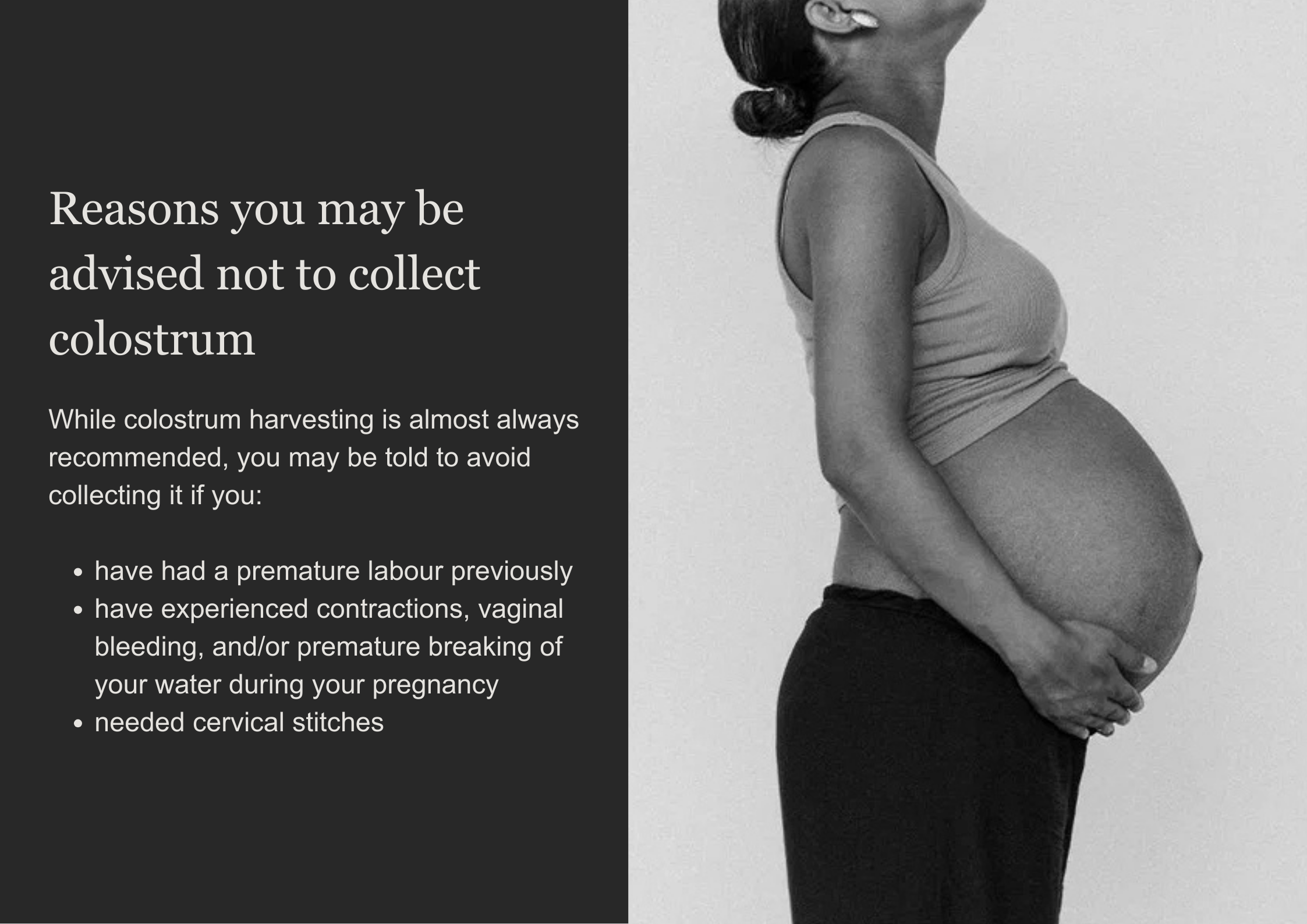
When to start collecting colostrum
It’s possible to collect colostrum by hand from 36 weeks of pregnancy, and you can express it up to 3 times daily. If you’re expecting twins, you can start colostrum collection from 32 weeks of pregnancy.
How to harvest colostrum
You should only use your hands for expressing colostrum during pregnancy as It’s recommended that you don’t use a breast pump to express breast milk until after your baby has been born.
Before you begin to hand express and collect colostrum, be sure to speak to your midwife or a healthcare professional first as they can help make sure it’s right for you and your baby, as well as answer any questions you have.
Over time, you can increase the amount of time you spend expressing until you’re spending between 5 to 10 minutes a time gently expressing, up to 5 times a day. You can then express as regularly as needed in the first few days after your baby arrives.
Colostrum collection hygiene guidelines
Before you start expressing, make sure your hands are clean, have some sterilised oral syringes to hand and a larger sterilised container.
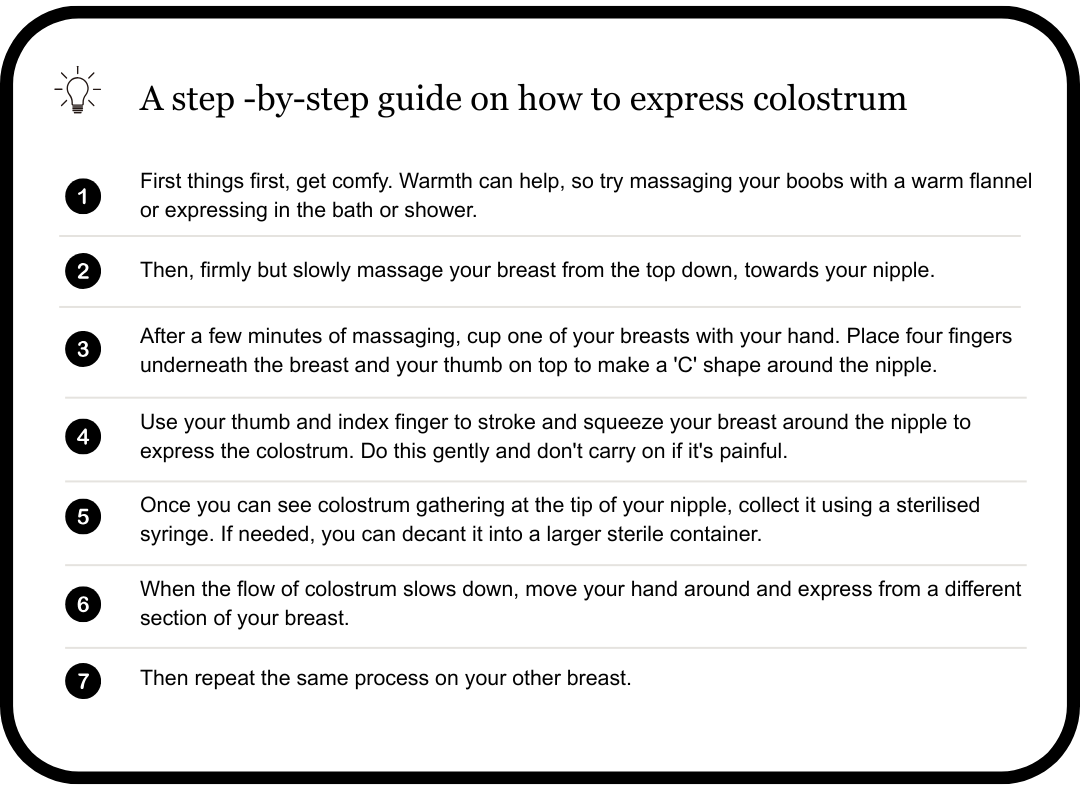
How do I collect colostrum with a syringe?
Follow these simple steps to collect colostrum with a syringe:
- Thoroughly clean your hands first.
- Gently massage your breast to stimulate milk flow and express a few drops of colostrum.
- Sterilise the syringe and remove its plunger.
- Place the syringe at the base of your nipple and slowly pull back on the plunger to collect the colostrum.
- Label the syringe with the date and time of collection before storing it in the fridge or freezer.
How to store colostrum
Once collected, proper storage of collected colostrum includes dating and labelling the syringes before storing them in your freezer, ready to give to your baby once they arrive.
When you label your syringes, be sure to include:
- your name
- the date and time the colostrum was expressed
How long can I store collected colostrum?
You can store your expressed colostrum syringes at the back of the fridge between 2°C and 4°C for up to 24 hours before you freeze it if required.
Once frozen, it can be stored for up to 6 months, but for the best quality, use within 3 months.
How to take your colostrum into hospital
To bring your expressed colostrum into the hospital for post-delivery, you’ll need:
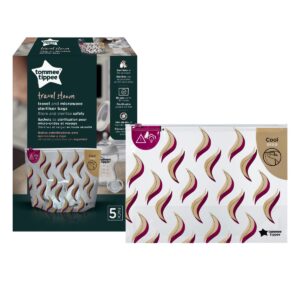
- re-sealable bags
- a small cool bag
- a bag of crushed ice or some ice blocks.
When you’re going to the hospital to give birth, you can place some of your frozen colostrum syringes in a re-sealable cool bag between a bag of crushed ice or some ice blocks. The colostrum will last for up to 24 hours when kept this way.
You should tell your midwife that you have colostrum with you when you arrive at the hospital as they will label it and store it in the fridge or freezer at the hospital for you.
Feeding your baby colostrum
Some newborn babies struggle to breastfeed at first, and others are unable to maintain their blood sugar levels. In these situations, your expressed colostrum is the perfect first food for your baby.
Before you feed your baby, the syringe needs to be brought to room temperature. To do this, you can place the bag with the syringe in into warm water. Then, your midwife should demonstrate how to use a small cup or syringe to feed it to your baby.
Having a small feed with colostrum helps give your newborn a boost in energy and blood sugar levels. It can also help to encourage them to breastfeed.
How to increase colostrum production
To ensure you produce a good amount of colostrum, you should stay hydrated, eat a balanced diet, ensure you’re resting during pregnancy and keeping your stress levels down through proper relaxation.
It’s important to note that colostrum harvesting triggers a rise in oxytocin (the hormone that produces contractions in labour). On rare occasions, it can also stimulate Braxton Hicks contractions. Don’t worry though, it’s very unlikely that collecting your colostrum will trigger labour.
If you experience mild labour contractions or cramps that feel like period pain, it’s recommended that you stop collecting colostrum. Then, take some time to rest before trying again. If contractions continue while you’re collecting colostrum, you should seek medical advice and wait until you’re closer to your due date before starting again.
Expressing by hand is the simplest and safest way to collect colostrum, avoiding the use of pumps until post-labour.
How much colostrum you can collect in an expressing session can vary from just a few drops to a teaspoon full. Don’t compare yourself to others who are doing the same and remember that every drop counts!
Colostrum supports your baby’s immune system, development and can help you establish a good breastfeeding routine from birth and beyond.
Colostrum is highly concentrated and produced in small amounts, but even just a small portion of your colostrum will be beneficial for your baby nutritionally as their stomach is only the size of a marble when they’re born.
You should avoid using a breast pump prior to giving birth as you’re more likely to stimulate uterine contractions, potentially leading to preterm labour. Hand expression when collecting colostrum is much gentler and less likely to stimulate the uterus, making it the safer option.
No, it’s not necessary to collect every single drop of colostrum, even a small amount is packed full of nutrients and antibodies for your baby. Only express as little or as much as you can comfortably and aim to feed it to your baby during their first few days.